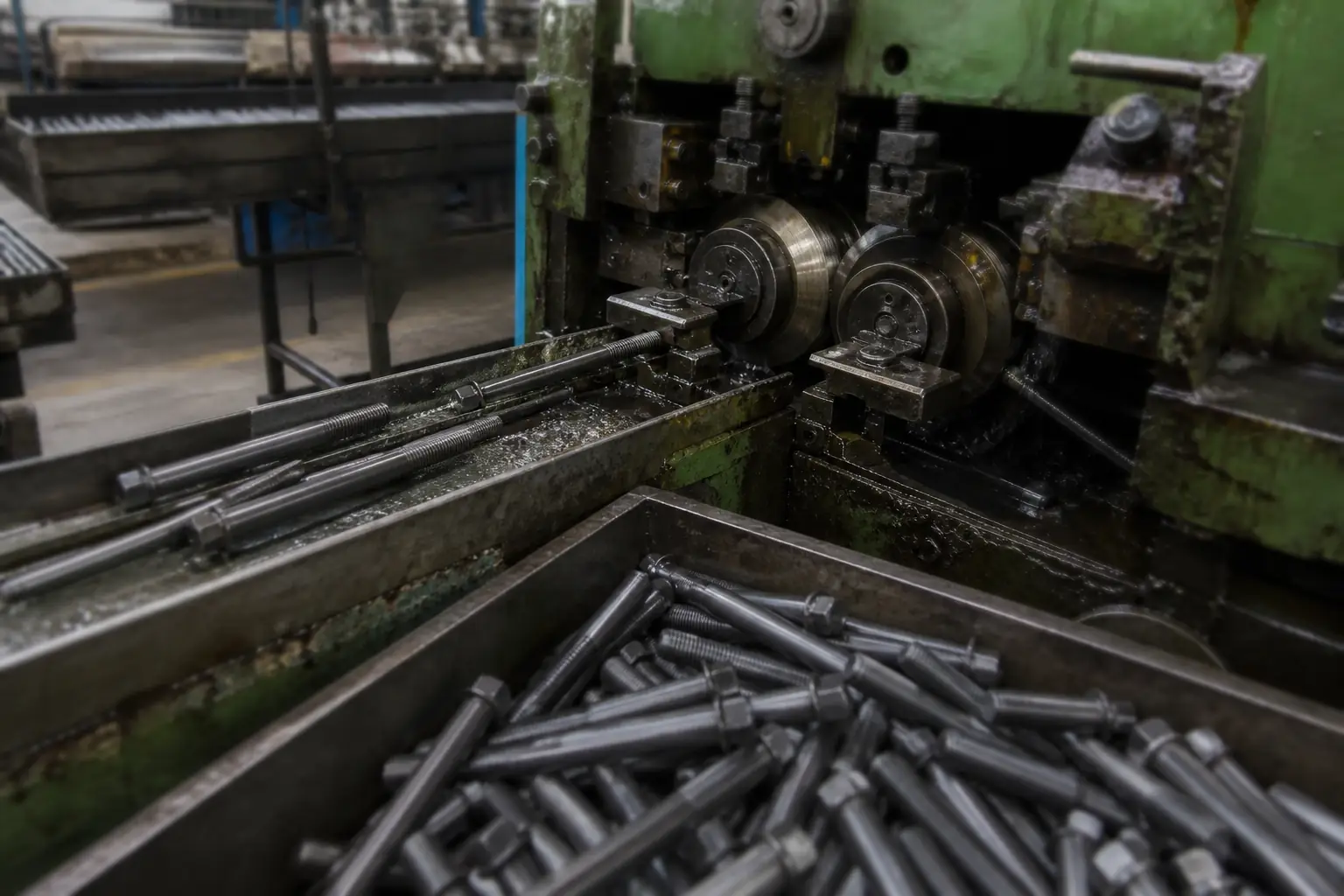
M36 is one of the standard coarse-thread sizes for studs & threaded rods under DIN 939 / DIN 975. The sections below reproduce the dimensional row, list the matching tools and hole sizes, and summarize where this size is normally specified.
M36 Dimensional Row (DIN 939 / DIN 975)
| Thread size | Pitch (mm) | Point type | Common lengths (mm) | Reference standard | Notes |
|---|---|---|---|---|---|
| M36 | 4.0 | M36 | 70~300 | DIN 939 | Stud, equal thread both ends |
Hole Sizes for M36
| Coarse-thread pitch (ISO 724) | 4 mm |
|---|---|
| Through-hole / clearance (ISO 273 medium) | 39 mm |
| Tapping drill, coarse thread | 32 mm |
Tightening Torque for M36
| Class 8.8 (dry, ~µ 0.125) | ≈ 2450 Nm |
|---|---|
| Class 10.9 (dry, ~µ 0.125) | ≈ 3450 Nm |
| Class 12.9 (dry, ~µ 0.125) | ≈ 4150 Nm |
Indicative dry-joint values. Lubrication can lower the required torque by 15–25%. Always confirm against the joint design, especially when going up a strength class.
Proof Load & Strength for M36
| Tensile stress area As (ISO 898-1) | 817 mm² |
|---|---|
| Proof load, class 8.8 | 490 kN |
| Proof load, class 10.9 | 678 kN |
| Proof load, class 12.9 | 792 kN |
| Min. ultimate tensile, class 8.8 | 654 kN |
Proof load = stress area × proof stress per ISO 898-1. Design joints so the working preload stays below the proof load of the selected class.
Common Applications for M36 Studs & Threaded Rods
M36 Studs & Threaded Rods are commonly specified for structural steelwork, heavy machinery foundations and large flange joints.
Mating Parts for M36
For M36, pair with a M36 hex nut (ISO 4032 / DIN 934) and, where used, a M36 flat washer (ISO 7089 / DIN 125A) under the head and under the nut.